Key Takeaways
- Google does not discourage guest articles that inform another site’s audience; it objects when the main intent is building links at scale.
- Paid links are allowed when marked rel=sponsored or rel=nofollow; paid links that pass ranking credit count as link spam.
- Keyword-rich anchors, the same article on many sites and writers who do not know the topic are Google’s named warning factors.
- In the US, the FTC expects paid content to be disclosed clearly, so label sponsored guest posts where readers will see it.
Is guest posting safe? Yes, when the article is written for another site’s readers and any paid link is labeled, and no, when the main goal is to push keyword-rich links across many sites. Google’s own guidance draws that line, and it has repeated it for years.
The confusion comes from mixing two different things. An editorial guest post that informs an audience is ordinary publishing. A campaign that buys followed links in bulk is what Google’s link spam policy describes. Most placements sit somewhere in between, so buyers need to know which details move a post from one side to the other.
This guide sets out what Google’s spam policies, its 2017 and 2019 link guidance, the December 2022 link spam update and the site reputation abuse policy actually say. It adds the FTC’s disclosure expectations and turns everything into a checklist you can use before paying for any placement.
In This Guide
- Is Guest Posting Safe? The Short Answer
- What Google’s Link Spam Policy Covers
- Four Warning Factors From Google’s 2017 Reminder
- How to Label Paid and Sponsored Links
- Where Site Reputation Abuse Fits In
- Disclosure Rules for Sponsored Guest Posts
- Is Guest Posting Safe for Your Site? A Risk Checklist
- Guest Posting Safety Questions
Is Guest Posting Safe? The Short Answer
Google does not treat guest posting itself as spam. In its 2017 reminder about links in large-scale article campaigns, Google said it does not discourage contributor or guest articles when they inform users, educate another site’s audience or bring awareness to a cause or company.
The same post draws the line clearly: its guidelines are violated when the main intent is to build links in a large-scale way back to the author’s site. That is why the honest answer to “is guest posting safe” depends on intent and execution more than on the tactic.
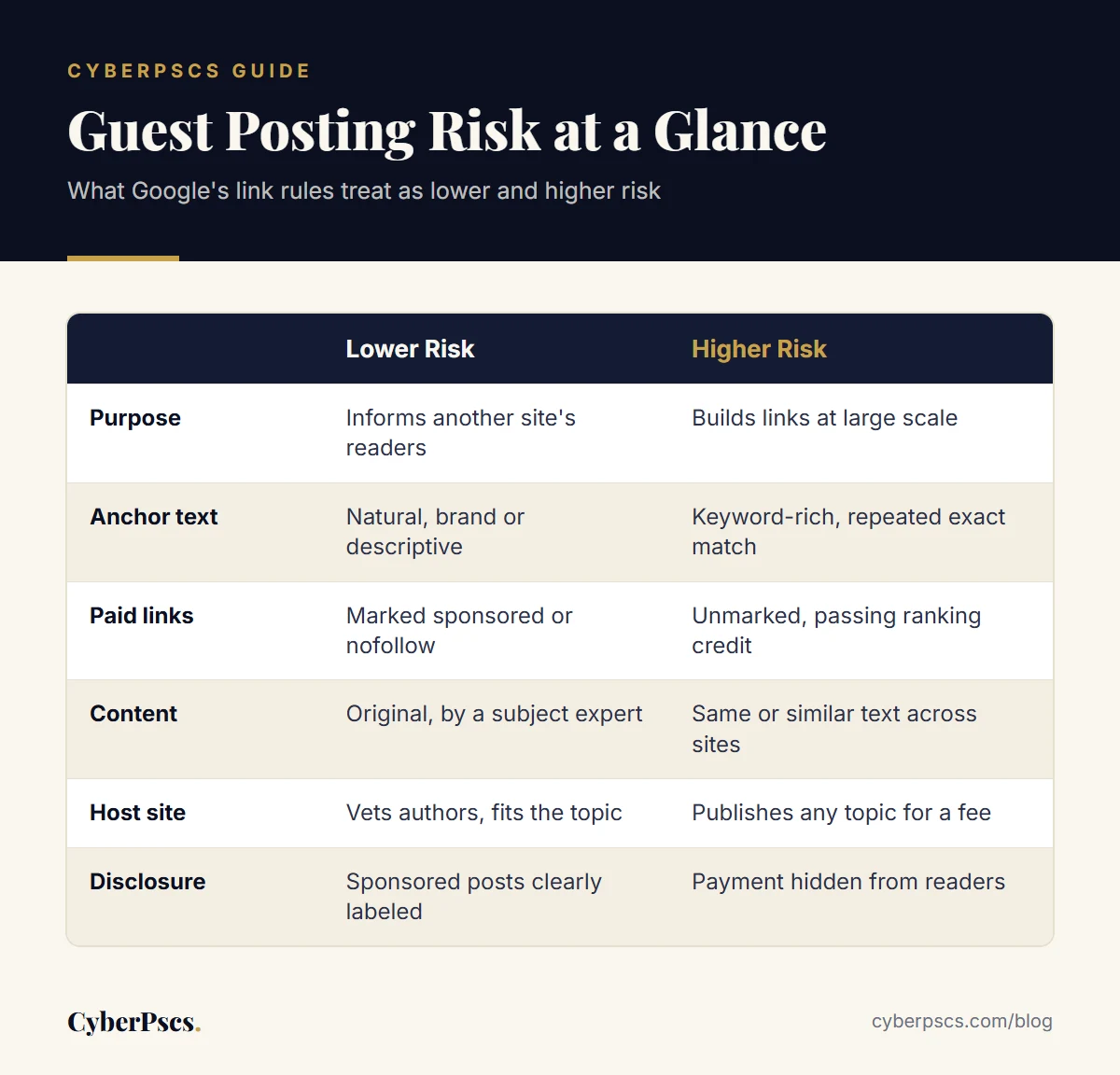
- Lower risk: an original article on a relevant site, written by someone who knows the subject, with natural links that help the reader.
- Higher risk: the same pitch sent to dozens of sites, keyword-rich anchors pointing at money pages, and paid links left unlabeled.
What Google’s Link Spam Policy Covers
Google’s spam policies say that links intended to manipulate rankings in Google Search results may be considered link spam. Two examples on that list matter most to guest post buyers.
Examples That Mention Guest Posts
- Buying or selling links for ranking purposes, which the policy says includes exchanging money for links or for posts that contain links.
- Advertorials or native advertising where payment is received for articles with links that pass ranking credit, or links with optimized anchor text in articles, guest posts or press releases distributed on other sites.
What the Exception Allows
The same policy says Google understands that buying and selling links is a normal part of the web’s economy for advertising and sponsorship. Such links are not a violation as long as they are qualified with rel=”nofollow” or rel=”sponsored”. In practice, a paid placement is acceptable to Google when its links do not try to pass ranking credit.
Four Warning Factors From Google’s 2017 Reminder
The 2017 post addresses contributor posts, guest posts, partner posts and syndicated posts by name. It lists factors that, taken to an extreme, can indicate an article violates Google’s guidelines:
- Stuffing keyword-rich links to your site into your articles.
- Having the articles published across many different sites, or a large number of articles on a few large sites.
- Using or hiring writers who are not knowledgeable about the topics they write on.
- Using the same or similar content across these articles, or duplicating the full content of articles from your own site.
The post also warns publishers. When Google detects that a website publishes articles containing spammy links, this may change its perception of the site’s quality and could affect its ranking. It suggests hosts vet contributors by asking whether they know the person, whether the message fits their audience, whether the article is useful and whether links of questionable intent use rel=”nofollow”.
Google’s December 2022 link spam update went further, using its SpamBrain system to neutralize the impact of unnatural links. A host with standards therefore protects your placement too, and our guest post red flags checklist shows how to spot hosts without them.
How to Label Paid and Sponsored Links
In September 2019 Google added two new link attributes alongside nofollow.
Which Value to Use
- rel=”sponsored” for links created as part of advertisements, sponsorships or other compensation agreements.
- rel=”ugc” for links in user-generated content, such as comments and forum posts.
- rel=”nofollow” for other cases where you want to link without implying any type of endorsement, including passing ranking credit.
Hints, Not Directives
Google said all three values would be treated as hints about which links to consider or exclude within Search, and that from March 1, 2020 nofollow would also become a hint for crawling and indexing. Existing nofollow links did not need to change, and the spam policies still accept nofollow on paid links.
Is guest posting safe when money changes hands? It can be, if the paid link carries sponsored or nofollow and the article is still worth reading. Agree the attribute in writing before you pay, then check it after publication by inspecting the link in your browser.
Where Site Reputation Abuse Fits In
In March 2024 Google added a site reputation abuse policy, along with new policies on scaled content abuse and expired domain abuse. It targeted third-party pages published on an established site mainly to take advantage of that site’s ranking signals, such as sponsored or partner pages that are independent of the host’s main purpose and produced without close oversight.
In November 2024 Google updated the policy to say that using third-party content in an attempt to exploit a site’s ranking signals is a violation regardless of any first-party involvement or oversight of that content.
For guest posting, the lesson is about scale and purpose. One relevant article that fits a site’s audience is ordinary publishing. A host that rents out a whole section for unrelated paid content is the pattern this policy describes, and placements inside such sections carry the most risk. Google has revised the wording of this section since, so check the current spam policies before relying on any summary.
Disclosure Rules for Sponsored Guest Posts
Search rules are only half of the picture. In the US, the FTC’s Endorsement Guides FAQ says that when there is a connection between an endorser and a brand that readers would not expect, such as payment or a free product, it should be disclosed clearly and conspicuously.
For a sponsored guest post, that usually means:
- a visible label such as Sponsored or Paid Partnership near the top of the article, not buried in a footer;
- plain wording that readers understand without clicking anything;
- links to the sponsor marked rel=”sponsored”, which covers Google’s side of the same arrangement.
An unpaid editorial guest post with an author bio needs no sponsorship label, but it should still be honest about who wrote it and why.
Is Guest Posting Safe for Your Site? A Risk Checklist
Use this table to judge any placement before you pay. It summarizes the sources above; it is not legal advice.
| Practice | Risk | Why |
|---|---|---|
| Original article for a relevant audience, natural links | Lower | Google says it does not discourage articles that inform or educate another site’s audience |
| Paid placement with links marked sponsored or nofollow | Lower | The spam policies accept qualified paid links |
| Clear sponsored label on paid content | Lower | Matches the FTC’s call for clear disclosure |
| Keyword-rich anchors pointing at money pages | Higher | Named in the 2017 warning factors and the link spam policy |
| Same article placed on many sites | Higher | Named in the 2017 post as a sign of large-scale link building |
| Paid links that pass ranking credit | Higher | The spam policies count them as link spam |
| Placement in a host’s unrelated third-party section | Higher | The pattern the site reputation abuse policy targets |
Then vet the host itself. Our guide to finding guest post sites worth paying for covers traffic, topic fit and editorial standards, niche guest posting explains why relevance matters, and DA vs DR shows what authority scores leave out. Every site in the CyberPscs guest post directory is checked with the same verification method, and you can browse by subject, such as news guest post sites.
Guest Posting Safety Questions
Is guest posting safe for new websites?
It can be, as long as the placements are editorial, relevant and few. A new site gains nothing from dozens of keyword-rich links on unrelated blogs, and Google’s 2017 guidance lists large-scale placements and keyword-stuffed links among its warning factors. Focus on a handful of useful articles on sites your customers actually read.
Is guest posting safe if the link is nofollow?
A nofollow or sponsored link meets Google’s requirement for paid links, so it does not break the link spam policy. Since 2019 Google treats these values as hints, so it may still consider the link, but the placement is not a violation. The article can also send referral visitors and reach new readers.
Can Google penalize my site for guest posts?
Google’s December 2022 link spam update focused on neutralizing unnatural links, which means the credit they pass is lost. Google can also take manual action against unnatural links, and its 2017 post says sites publishing articles with spammy links may be seen as lower quality. Natural links and qualified paid links avoid both problems.
Do I need to label a sponsored guest post?
In the US, the FTC’s Endorsement Guides FAQ says a connection readers would not expect, such as payment, should be disclosed clearly and conspicuously, so paid content should carry a visible label. Google separately asks for paid links to use rel=sponsored or rel=nofollow. Doing both keeps the post honest for readers and compliant for search.
What makes a guest post look like a link scheme?
Google’s 2017 post names four factors that, taken to an extreme, can indicate a violation: keyword-rich links stuffed into articles, articles published across many sites, writers who do not know the topic, and the same or similar content repeated across articles. Avoid all four and most of the risk goes away.
So is guest posting safe? It is when the article serves the host’s readers, the host vets what it publishes, anchors stay natural and every paid link is marked sponsored or nofollow. It becomes risky when links come first: bulk placements, keyword-rich anchors and unlabeled payments are exactly what Google’s policies describe.
The safest habit is simple: choose the host for its readers first, and treat the link as a bonus that must be labeled whenever money changes hands. Start with sites that pass those checks. Browse the directory or ask us about a placement that fits your niche and your rules.