Key Takeaways
- Build your list from three sources: search operators, curated directories that publish their method, and sites already hosting your competitors’ guest posts.
- Moz DA and Ahrefs DR describe link profiles, not readers. Check steady organic traffic in your target country before trusting either score.
- Read ten recent posts before paying: topic fit, rhythm, outbound links and editing show whether a site serves readers or links.
- Google says publishing articles with spammy links may change its view of a site’s quality, so a host’s standards protect your placement too.
Knowing how to find guest post sites worth paying for comes down to two jobs: building a list of candidates from the right sources, then vetting each site for real readers, topic fit and a clean link profile. Skip the second job and you can end up paying for an impressive score on a site almost nobody reads.
Authority metrics are where many buyers go wrong. A site can show a high Domain Authority or Domain Rating and still earn very little search traffic, because both scores are calculated mainly from link data, not visitor numbers.
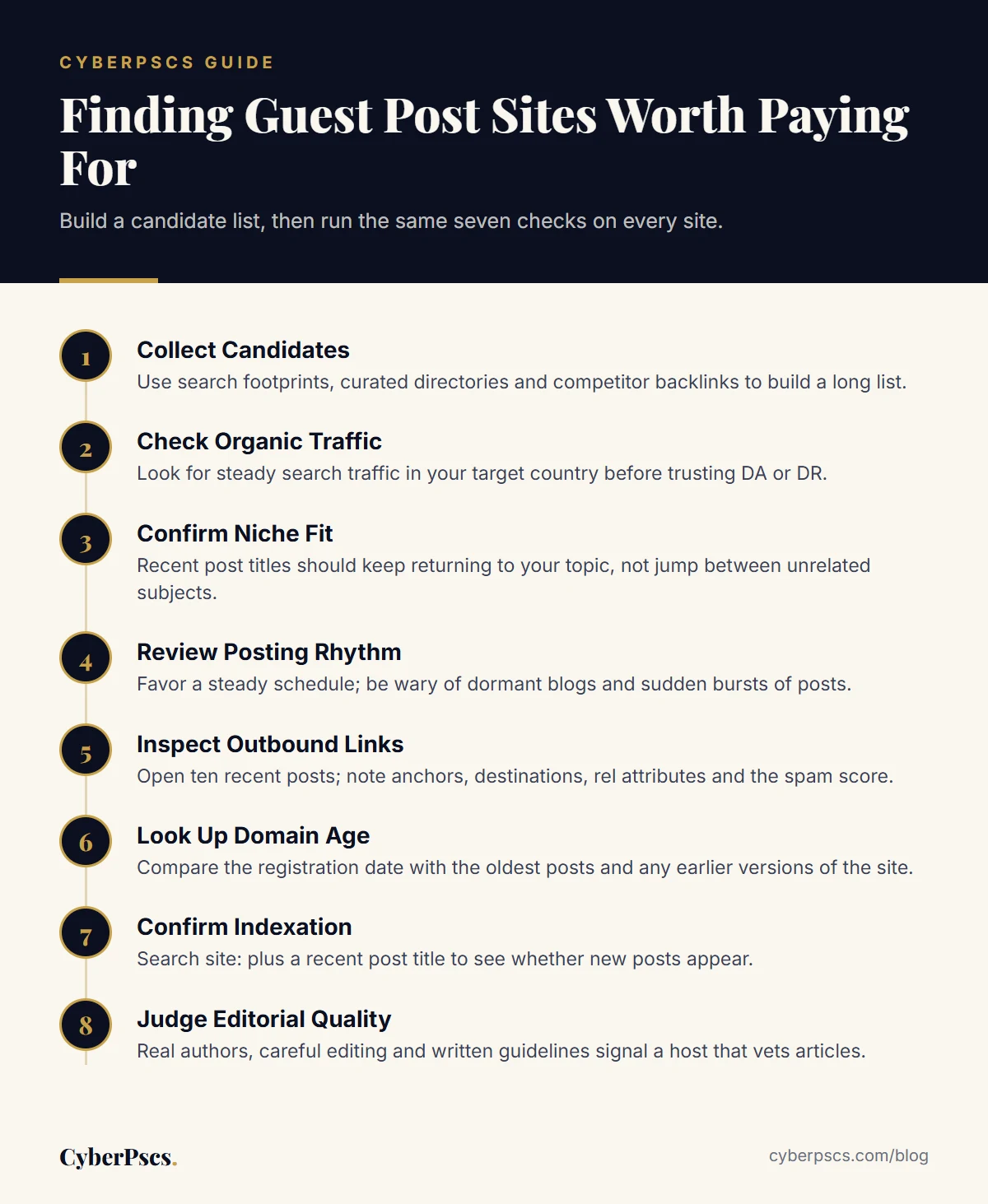
This guide covers how to find guest post sites step by step. You get search footprints for building a list, seven checks to run on each candidate, a checklist you can reuse and a worked example built on live CyberPscs listings, with every metric checked on 29 September 2026.
In This Guide
- Where to Find Guest Post Sites
- Check Real Organic Traffic Before Authority Scores
- Confirm Niche Fit and a Steady Posting Rhythm
- Inspect Outbound Links and Spam Signals
- Verify Domain Age and Indexation
- Judge the Editorial Standards
- A Checklist for Vetting the Guest Post Sites You Find
- Finding Guest Post Sites Through a Vetted Directory
- Questions Buyers Ask Before Paying for a Guest Post
Where to Find Guest Post Sites
The first half of learning how to find guest post sites is building a long list, because many candidates will fail the checks that follow. Pull from all three sources below.
Search Operators That Surface Open Submissions
Pair your topic with the phrases sites use on their contributor pages, replacing [topic] with your own subject:
- [topic] “write for us”
- [topic] “guest post by”
- [topic] “submit a guest post”
- [topic] intitle:”write for us”
- [topic] inurl:contribute
The “guest post by” footprint tends to be the most useful, because it finds sites that have actually published contributors rather than sites that only say they accept them. Treat every result as a lead, not a recommendation.
Curated Directories With Published Metrics
A curated directory handles the first round of number-gathering. Use one that shows metrics for each listing and explains how it checks sites, so you can judge every entry yourself. The CyberPscs directory of verified guest post sites lists each site with its Moz DA, Ahrefs DR, US organic traffic, keywords, spam score, referring domains, domain age and an A to D traffic grade.
Competitor Backlinks That Reveal Proven Hosts
Run two or three competitors through a backlink tool such as Ahrefs, Semrush or Moz Link Explorer, then scan the linking pages for bylined articles written by their team. A site that has already published a competitor’s guest post has shown it accepts contributions in your space. Add it to the list and vet it like any other candidate.
Check Real Organic Traffic Before Authority Scores
Domain Authority and Domain Rating are handy for comparing link profiles, but neither one counts readers. Moz describes Domain Authority as a prediction of how likely a site is to rank, calculated mainly from backlink data, and says it is not a Google ranking factor. Ahrefs states that Domain Rating is purely link-based and does not take a site’s search traffic or domain age into account.
Read Organic Traffic Three Ways
- Trend: steady or rising traffic over the past year beats one strong month. Be wary of a sharp spike followed by a long slide.
- Country: traffic from the market you sell to is what counts. Big numbers from elsewhere may do little for a brand that sells in the US.
- Keywords: check what the site ranks for. Traffic from a handful of off-topic terms says less than rankings spread across its own subject.
Ask for First-Party Proof
Traffic figures in SEO tools are estimates, so for a larger budget ask the owner for a screenshot of their Search Console Performance report. It shows clicks from Google Search, can group the data by country and can be switched to a monthly view for longer-term trends. For more on the two authority scores, see our explainer on how DA and DR differ.
Confirm Niche Fit and a Steady Posting Rhythm
Match the Topic, Not Just the Category
Open the site’s 20 most recent post titles. If your subject comes up again and again, the readers there already care about it and your link will sit among related content. If the site jumps from crypto to pet care to wedding dresses, its category label means little. Our guide to why topic relevance beats raw authority goes deeper, and a subject list such as the technology guest post sites shows candidates already grouped by topic.
Check the Publishing Rhythm
Scroll the blog archive and note the dates. A steady rhythm, weekly or daily, suggests someone is running the site. Be wary when the newest post is months old, because a dormant blog is unlikely to send you visitors. Be just as careful when a small site suddenly publishes dozens of unrelated posts a day, a volume no small team can edit properly.
Inspect Outbound Links and Spam Signals
Audit Ten Recent Posts
Your post will share the site with every link it publishes, so study them. Open ten recent posts and note how many external links each one carries, where they point and what anchor text they use. Right-click a link and choose Inspect to see its rel attribute.
Google’s reminder about links in large-scale article campaigns lists stuffing keyword-rich links into articles among the factors that, taken to an extreme, can indicate a violation of its guidelines. It adds that when Google detects a site publishing articles that contain spammy links, this may change its perception of the site’s quality and could affect its ranking. Your post sits on that site, so its standing matters to you.
- Be wary when nearly every recent post carries a commercial link with an exact-match anchor.
- Treat anchors for loans, pharmacies or gambling on a site about something else as a warning sign.
- Note how paid links are marked. Google’s spam policies list paid articles whose links pass ranking credit as link spam, but say links bought for advertising or sponsorship are not a violation when qualified with rel=”sponsored” or rel=”nofollow”.
Our list of guest post red flags covers more warning signs, and our guide to Google’s link spam rules explains where guest posting stands.
Read Spam Scores With Care
If a tool shows a spam score, read it the way Moz explains its Spam Score: the percentage of sites with similar features that Moz found penalized or banned by Google. Moz calls 1% to 30% low and treats a high score as a sign to investigate further, not proof that a site is spammy.
Verify Domain Age and Indexation
Domain Age Is Context, Not a Verdict
A WHOIS or RDAP lookup usually shows when a domain was registered, which tells you how old the name is, not how long the current site has used it. The same Google spam policies describe expired domain abuse: buying an expired domain and repurposing it primarily to manipulate search rankings with content that offers users little or no value. Compare the registration date with the site’s oldest posts, and if the Internet Archive’s Wayback Machine shows an unrelated business on the domain a few years ago, ask the owner about the change.
Make Sure Google Can Find the Posts
Search Google for site: followed by the domain, then search for the exact title of a post published a few weeks ago. If older posts appear but recent ones never do, ask why before you pay. A post that never shows up in search results cannot send you search visitors, whatever the site’s scores say.
Judge the Editorial Standards
Read three recent posts from start to finish. Look for named authors with real bios, careful editing, original examples and images that belong to the article. Posts that read like a template with a link bolted on show you the company your article will keep.
Then look at how the site treats contributors. The same 2017 Google post says sites accepting articles should vet them with questions such as: Do I know this person? Does this person’s message fit with my site’s audience? Does the article contain useful content? A host that asks similar questions about your pitch, requests edits or turns down weak drafts is protecting the asset you are paying to join. Before you pay, get the terms in writing: word count, number of links, which link attributes apply and how sponsored posts are labeled.
A Checklist for Vetting the Guest Post Sites You Find
Run every candidate through the same seven checks, including sites you found in a directory. One weak result may be acceptable; several together are a reason to walk away.
| Check | How to Run It | Be Wary When |
|---|---|---|
| Organic traffic | Review a year of traffic in an SEO tool; ask for a Search Console screenshot | Authority is high but traffic is tiny, falling or from the wrong country |
| Niche fit | Read the 20 latest post titles and the category list | Your topic rarely appears or the site covers everything |
| Posting rhythm | Check the dates in the blog archive | The newest post is months old or volume jumps overnight |
| Outbound links | Open ten recent posts; note anchors, destinations and rel attributes; look up the spam score | Nearly every post carries an exact-match commercial link |
| Domain age | Run a WHOIS or RDAP lookup and compare it with the oldest posts | The site’s history does not match its registration date |
| Indexation | Search site: with the domain, then a recent post title | Recent posts never appear in results |
| Editorial quality | Read three posts in full and ask for written guidelines | Posts are thin, unedited or have no real authors |
Finding Guest Post Sites Through a Vetted Directory
A directory is the quickest answer to how to find guest post sites with the numbers already gathered, but it cannot replace your judgment. Here is how four live CyberPscs listings compare, with metrics checked on 29 September 2026.
| Site | DA | DR | US Organic Traffic | Keywords | Domain Age | Spam Score | Grade |
|---|---|---|---|---|---|---|---|
| techtrendery.com | 44 | 50 | 19,090 | 66 | 2y 8m | 4% | A |
| coyyn.com | 41 | 48 | 13,838 | 166 | 8y 11m | 3% | A |
| bithoex.com | 42 | 60 | 5,959 | 49 | 6m 6d | 2% | B |
| webinkey.com | 57 | 55 | 18 | 11 | 4y 9m | 5% | D |
What the Numbers Show
The listing for webinkey.com shows the highest DA of the four and a DR of 55, yet its US organic traffic figure is 18 and it carries a D grade. Both techtrendery.com and coyyn.com show lower authority scores, far more traffic and an A grade. The listing for bithoex.com shows a domain just over six months old with 5,959 in US organic traffic, so a buyer filtering on domain age alone would have missed it. None of this is a verdict on any site; it shows what each metric does and does not measure.
What Is Still Yours to Check
The How We Verify page explains the method behind the listings. Before you pay, still read recent posts against your topic, look at the outbound links and agree on link attributes and labeling.
Questions Buyers Ask Before Paying for a Guest Post
How to find guest post sites in a very specific niche?
Pair your niche terms with contributor footprints such as ‘write for us’ or ‘guest post by’, then use a backlink tool to see which sites already host your closest competitors’ guest posts. If the niche is tiny, widen to the parent topic and judge each site on its recent post titles. A smaller site that covers your exact subject often beats a large general one.
Should I choose a guest post site by DA or DR?
Neither score should decide on its own. Moz says Domain Authority is not a Google ranking factor, and Ahrefs describes Domain Rating as purely link-based, leaving out search traffic and domain age. Both help you compare link profiles. Shortlist sites on steady organic traffic in your market, topic fit and editorial quality, then use DA and DR to compare the sites that pass.
What spam score is too high for a guest post site?
Moz defines its Spam Score as the percentage of sites with similar features that it found penalized or banned by Google. It calls 1% to 30% low, 31% to 60% medium and 61% to 100% high. Moz also says a high score does not necessarily mean a site is spammy; it is a signal to look more closely at the site’s quality and relevance.
Is it safe to pay for a guest post?
Google’s spam policies count buying links for ranking purposes as link spam, but say links bought for advertising or sponsorship are not a violation when marked rel=sponsored or rel=nofollow. Google has also said it does not discourage guest articles that inform users or educate another site’s audience. Pay for placements on sites with real readers and agree in advance how the link will be marked.
How can I check if a guest post site is indexed?
Search Google for site: followed by the domain, then search the exact title of a post published a few weeks ago. If recent posts never appear, ask the owner why before paying. For stronger evidence, ask for a screenshot of the site’s Search Console Performance report, which shows clicks and impressions from Google Search over time.
Build the list from search footprints, directories and competitor backlinks, then hold every site to the same seven checks: verifiable traffic, a close topic match, a steady rhythm, restrained outbound links, a history that makes sense, indexed posts and real editing. Authority scores come last, as a tiebreaker between sites that have already passed.
Now that you know how to find guest post sites that earn their fee, save yourself the manual metric work: browse the directory’s live listings or ask us about a placement in your niche.