Key Takeaways
- A guest post on a smaller site in your exact topic often reaches more interested readers than one on a big general blog.
- Google says its link analysis systems use how pages link to each other to understand what pages are about.
- Judge fit from recent post titles, focused categories, outbound links and authors, then use DA and DR to compare sites that pass.
- Browse by subject to shortlist hosts whose readers already care about your topic.
Niche guest posting means placing your articles on sites whose readers and content match your topic, even when those sites have lower authority scores than big general blogs. For most brands it is the better trade: a smaller audience that cares about your subject beats a large one that scrolls past it.
Authority scores make general sites look attractive. A general blog with a high DA can seem like a better deal than a focused site half its size. But a link from an article nobody in your market reads rarely sends visitors, and it sits awkwardly among unrelated posts.
This guide explains why relevance often beats raw authority, how to judge a site’s niche fit before you pitch, and how to match your brand to the subject groups in the CyberPscs directory, using live listings checked on 29 September 2026.
In This Guide
- What Niche Guest Posting Means
- Why Topic Relevance Often Beats Raw Authority
- How to Judge Niche Fit Before You Pitch
- Niche Guest Posting by Subject
- Worked Example: Two Listings, Two Kinds of Fit
- When a General Site Still Makes Sense
- A Niche Guest Posting Checklist
- Niche Guest Posting Questions
What Niche Guest Posting Means
Niche guest posting is simple to define: you write for sites that already publish about your subject, for readers who already care about it. A project-management tool writes for a technology or productivity blog, a financial adviser writes for a personal finance site, and a travel brand writes for travel readers.
The opposite is the general blog that accepts any topic. Its scores may be higher, but your article sits between posts about pet food and crypto, read by people who did not come for your subject. Niche guest posting trades some raw authority for a much closer match between your article, the host’s content and the people reading it.
Why Topic Relevance Often Beats Raw Authority
Readers Who Actually Care
A guest post earns its keep when people read it and some of them click through. Readers of a focused site arrived for that subject, so an article that extends it is more likely to hold their attention and send you visitors who match your customers. Authority scores cannot tell you that, because Moz DA and Ahrefs DR are built from link data. Our DA vs DR explainer covers what each score measures.
Links That Sit in Context
Google’s guide to its ranking systems says it has systems that understand how pages link to each other as a way to determine what pages are about. A link inside an article on the same subject, on a site about that subject, is easy for readers and those systems to understand. The same link wedged into an unrelated post is not.
Natural Anchors and Placement
Google’s SEO Starter Guide says link text tells people and Google something about the page you are linking to. On a relevant host you can use a plain, descriptive anchor exactly where a reader would want more detail. On an off-topic host, writers tend to force keyword-rich anchors to make the link look relevant, and stuffing keyword-rich links into articles is one of the warning factors in Google’s 2017 reminder about large-scale article campaigns.
A Smaller Footprint
A few placements on well-matched sites look like what they are: useful articles. Dozens of placements on general blogs look like a link campaign, and the same 2017 post lists articles published across many different sites among its warning factors.
How to Judge Niche Fit Before You Pitch
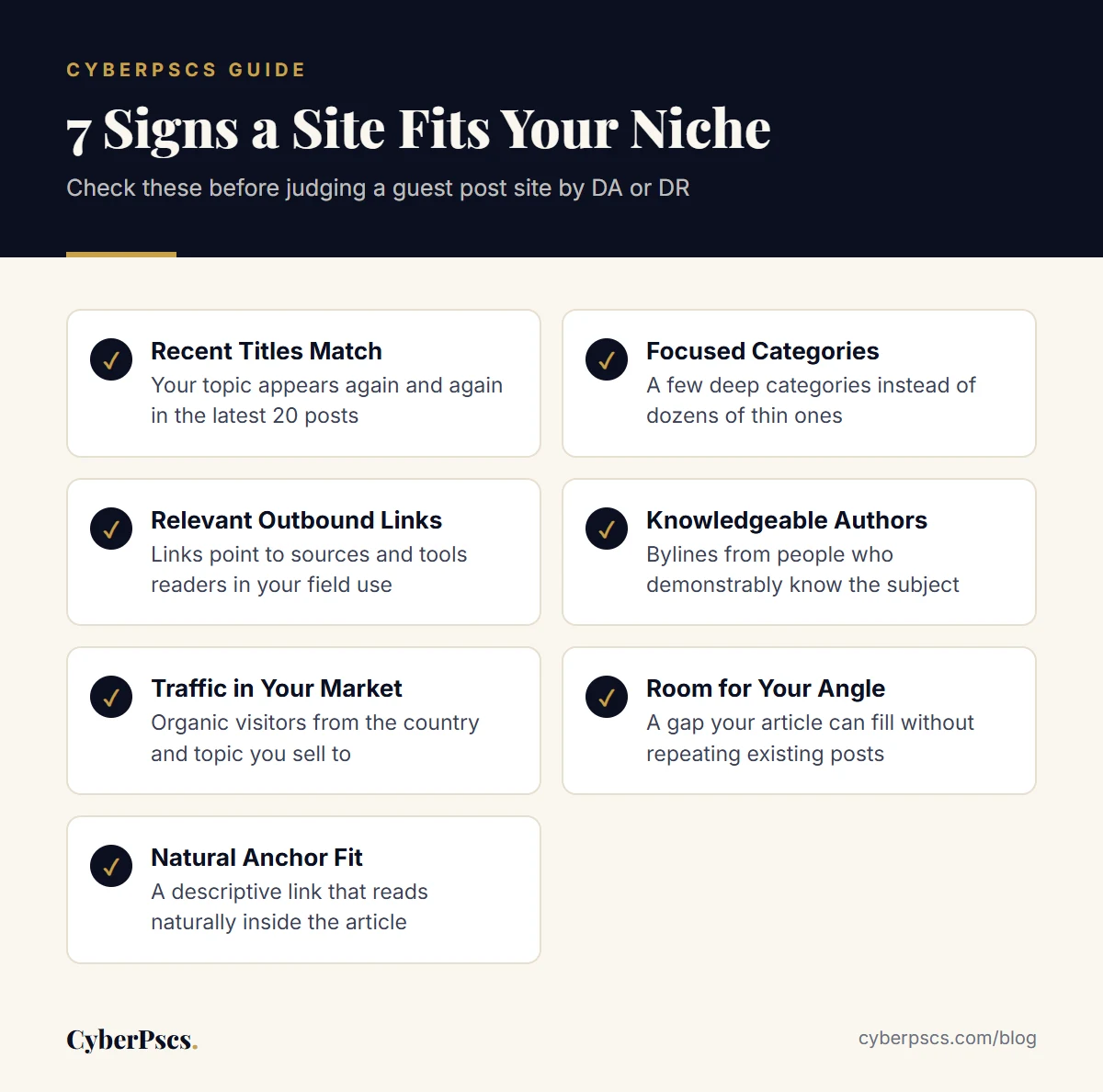
Niche fit is visible on the site itself. Spend ten minutes on these checks before you look at any score.
| Signal | Good Fit | Poor Fit |
|---|---|---|
| Recent post titles | Your topic appears again and again in the latest 20 posts | Your topic appears once, if at all |
| Categories | A few deep categories close to your subject | Dozens of thin categories on unrelated topics |
| Outbound links | Sources and tools your readers would use | Commercial links on unrelated subjects |
| Authors | Bylines from people who know the field | No authors, or one name on every topic |
| Search visibility | Traffic from keywords in your subject and market | Traffic from off-topic terms or another country |
Google’s own guidance points the same way. Its 2017 post suggests publishers ask whether a contributor’s message fits their site’s audience, and its guidance on helpful, people-first content asks whether content is written or reviewed by an expert or enthusiast who demonstrably knows the topic well. A host that applies those tests is a host worth joining. For the wider vetting routine, see how to find guest post sites worth paying for.
Niche Guest Posting by Subject
For niche guest posting, start from your customers’ interests rather than from a list of high scores. The CyberPscs guest post directory groups verified sites by subject, which makes the first cut quick:
- Software, apps, IT services and gadgets: technology guest post sites.
- Agencies, consultants, B2B services and startups: business guest post sites.
- Fintech, personal finance, insurance and investing: finance guest post sites, where accuracy and author expertise matter even more.
- Games, streaming, music and media: entertainment guest post sites.
- Broad announcements and general-interest stories: news guest post sites, judged section by section.
- Home, fashion and everyday living: the lifestyle subject.
Within a subject, keep narrowing. A cybersecurity product fits a technology site that covers security better than one that mostly reviews phones, even though both sit under the same heading.
Worked Example: Two Listings, Two Kinds of Fit
Here are two live CyberPscs listings, with figures checked on 29 September 2026. Both carry an A traffic grade; they differ in subject.
| Listing | Subject | DA | DR | US Organic Traffic | Keywords |
|---|---|---|---|---|---|
| techtrendery.com | Technology | 44 | 50 | 19,090 | 66 |
| backtofrontshow.com | Business | 54 | 60 | 7,023 | 56 |
A buyer who sorts by score alone picks backtofrontshow.com, which has the higher DA and DR. Now add the brand. A project-management software company has more in common with a site listed under technology, so techtrendery.com, with lower scores, is the closer match for its readers. A business coaching firm faces the opposite choice, and backtofrontshow.com becomes the natural host.
Neither site is better in general. The right host depends on who reads it, and the scores only help you compare sites that already fit. Before choosing either, read their recent posts to confirm the topic match, and see how we verify each listing for what the numbers cover.
When a General Site Still Makes Sense
Niche guest posting is not the only valid approach. Broad sites can make sense when:
- your news is genuinely general, such as a funding round, a public survey or a community project;
- the site has a section dedicated to your subject, with its own regular posts and readers;
- you want brand awareness among a wide audience more than referral clicks from specialists.
In those cases, judge relevance at the section level. A technology section with steady, recent posts on a news site can be a good host; a one-off post on the same site is not. Either way, check the host against our guest post red flags, because a site that publishes any topic for a fee often shows several of them.
A Niche Guest Posting Checklist
- Write down the topics your customers search for and the problems your article will solve.
- Shortlist hosts in the matching subject, then narrow to sites covering your exact topic.
- Read the latest 20 post titles and three full articles on each shortlisted site.
- Confirm organic traffic in your target market, then compare DA and DR among the sites that pass.
- Check outbound links in recent posts for relevance and restraint.
- Pitch an angle the site has not covered yet, written by someone who knows the subject.
- Use a descriptive anchor where a reader would want more detail, and agree how any paid link will be labeled, as explained in our guide on whether guest posting is safe.
Niche Guest Posting Questions
What is niche guest posting?
Niche guest posting means writing guest articles for sites that already cover your subject, for readers who care about it. Instead of chasing the highest DA or DR, you choose hosts whose recent posts, categories and audience match your topic, so your article and link sit in a relevant context.
Is a niche site with lower DA worth more than a general site with higher DA?
Often, yes, if the niche site has real organic traffic in your market and readers who match your customers. DA and DR are built from link data and do not measure topic fit or audience. Compare scores only among sites that already fit your subject, then decide.
How do I check whether a site fits my niche?
Read the latest 20 post titles, look at the category list, open three recent articles and check where their outbound links point. Then look at the keywords the site ranks for. If your topic keeps appearing and the links point to relevant resources, the fit is real.
Can a general news site work for niche guest posting?
It can when the site has a section dedicated to your subject, with regular recent posts and its own readers. Judge the section rather than the whole domain. A one-off placement on a news site that covers everything offers far less topical context than a post inside a focused section.
Does topic relevance affect how Google treats a link?
Google says its link analysis systems use how pages link to each other to understand what pages are about, and its SEO Starter Guide says link text tells people and Google about the linked page. Google does not publish a relevance score for links, so treat relevance as sound practice rather than a guaranteed boost.
Niche guest posting puts your article where it has the best chance of being read: on a site whose readers already care about your subject, next to posts that give your link context. Authority scores still help, but as a way to compare sites that already fit, not as the reason to choose a host.
Start with the subject that matches your customers, check the site’s recent posts and traffic, and pitch an article that adds something new. When you are ready, tell us your niche and we will suggest verified hosts that fit it.