Key Takeaways
- Moz DA predicts how likely a site is to rank against competitors; Ahrefs DR measures the relative strength of its backlink profile.
- Each tool uses its own data and formula. On 29 September 2026, 10 of 30 live CyberPscs listings had DA and DR 20+ points apart.
- Neither is a Google metric: Moz says DA is not a Google ranking factor, and DR is Ahrefs’ own relative score.
- Choose guest post sites on organic traffic, referring domains, spam score and content fit, using DA and DR only as a first filter.
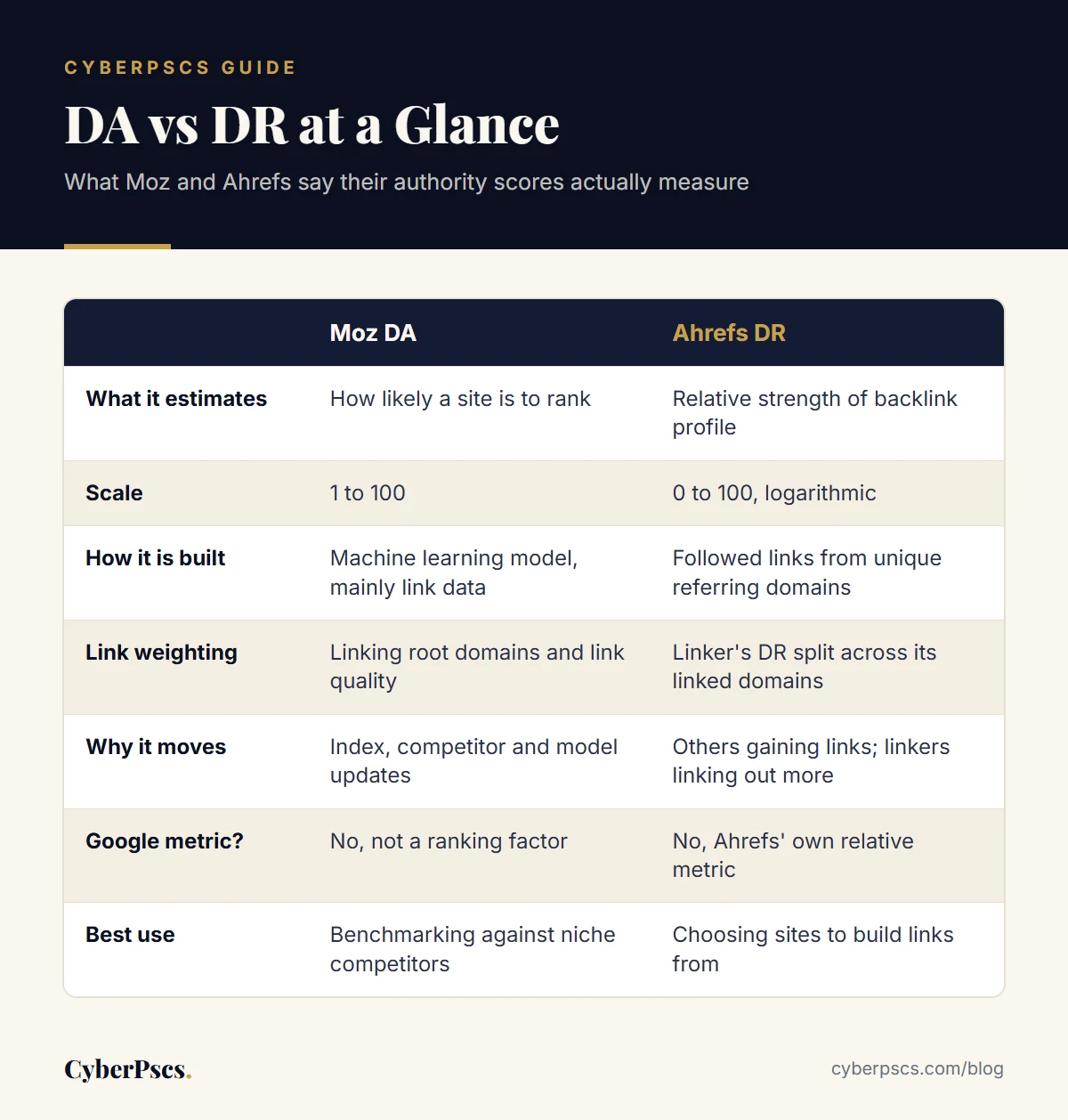
DA vs DR comes down to two different questions: Moz Domain Authority predicts how likely a site is to rank compared with its competitors, while Ahrefs Domain Rating measures the relative strength of its backlink profile. Both use a 100-point scale, both come from each company’s own link data, and neither is a Google metric.
That is why one domain can carry two very different numbers. The wealthylike.com listing in our directory shows DA 40 and DR 81 at the same time, and each figure can be accurate by its own tool’s rules.
For guest post buyers, the gap matters less than what sits behind it. This guide sets out what Moz and Ahrefs say each score measures, why the two drift apart, and how to judge a site on organic traffic, referring domains and spam score instead. Every example comes from live listings in the CyberPscs guest post directory, with figures checked on 29 September 2026.
In This Guide
- How Moz Calculates Domain Authority
- How Ahrefs Calculates Domain Rating
- Why DA vs DR Scores Disagree on the Same Domain
- Why Neither Score Is a Google Metric
- DA vs DR on Three Live CyberPscs Listings
- The Four Checks That Matter More Than Either Score
- A DA vs DR Checklist for Choosing a Guest Post Site
- Frequently Asked Questions About DA and DR
How Moz Calculates Domain Authority
Moz describes Domain Authority as a search engine ranking score that predicts how likely a website is to rank compared with competitors. Scores run from 1 to 100, and every new website starts at 1.
The engine is a machine learning algorithm. Moz says it weighs multiple factors, led by backlink data from its own Link Explorer index: the number of linking root domains, the quality of those links and other signals that correlate with rankings across thousands of search results.
Three details change how you should read a DA:
- It is relative. In Moz’s example, if Facebook gained a billion new links, other sites’ DA would drop relative to it. That is why Moz says climbing from 20 to 30 is easier than climbing from 70 to 80.
- It rates a whole domain or subdomain. Page Authority is Moz’s separate score for individual pages.
- It is not meant to stand alone. Moz names organic search traffic and keyword rankings among the metrics that complete the picture.
How Ahrefs Calculates Domain Rating
Ahrefs defines Domain Rating as the relative strength of a website’s backlink profile, measured on a logarithmic scale from 0 to 100. So the gap between DR 70 and 71 is much bigger than the gap between DR 20 and 21.
Ahrefs says it calculates DR in a somewhat similar way to PageRank, but between websites rather than pages. Simplified, it works in three steps:
- Find every domain with at least one followed link to the target.
- Count how many other domains each of those linking domains links to.
- Pass a share of each linking domain’s strength to the target: roughly its DR divided by the number of unique domains it links to.
The Link Rules That Follow
- Nofollow-only links do not raise DR.
- Only the first link from a domain counts; extra links from the same site add nothing.
- Homepage links and deep links contribute the same way.
- DR is purely link-based, so search traffic, domain age and brand popularity play no part.
The Ahrefs help center entry on DR adds a useful example: a DR 10 domain that links to three sites can influence your DR more than a DR 80 domain that links to a million.
Why DA vs DR Scores Disagree on the Same Domain
Side by side, the two methods make large gaps look expected, not suspicious. Of the 30 live listings in our directory on 29 September 2026, 10 showed a DA vs DR gap of 20 points or more, and none had identical scores. DA was the higher number on 17 sites and DR on 13.
Different Link Indexes
Each score is built from the links its own company has crawled: Moz’s Link Explorer index or Ahrefs’ database. One tool can count links the other has not found, and Moz names index updates that pick up more or fewer linking domains as one reason DA changes.
Different Formulas and Link Rules
DA is a machine learning prediction of ranking ability that draws on dozens of factors. DR is a link-flow calculation with published rules, such as ignoring nofollow-only links. The same backlink profile can look strong to one formula and ordinary to the other.
Relative Scales That Move Independently
Both scores are relative to every other site in each index. Ahrefs notes that when a DR 100 site gains more links, other sites are pushed down the scale. Moz says DA can move when other sites’ scores shift or when it updates its model, as it did with Domain Authority 2.0 in 2019.
The practical rule: never compare one site’s DA with another site’s DR. Compare DA with DA, or DR with DR, within the same niche.
Why Neither Score Is a Google Metric
Moz is explicit: Domain Authority is not a Google ranking factor and has no effect on search results. Ahrefs presents DR as its own metric, scored against the other sites in its database, and claims no more than a correlation with Google rankings, adding that its page-level URL Rating correlates better.
Google does analyze links, but with its own systems. Its guide to Google Search ranking systems describes link analysis systems that understand how pages link to each other, including PageRank, which it says remains part of its core ranking systems. DA and DR are outside models built from Moz’s and Ahrefs’ own crawls.
So treat both as forecasts. Moz frames DA as a prediction, and Ahrefs reminds readers that Google ranks pages, not websites, so a strong domain score cannot guarantee that your guest post will rank or send visitors.
If a seller’s pitch rests on DA or DR alone, ask what the site actually earns in Google. Our guide on whether guest posting is safe under Google’s link spam rules covers the policy side.
DA vs DR on Three Live CyberPscs Listings
These three listings show the most common DA vs DR patterns. Figures were checked on 29 September 2026; the sites are neutral examples, not endorsements or warnings.
| Listing | DA | DR | US Organic Traffic | Keywords | Referring Domains | Spam Score |
|---|---|---|---|---|---|---|
| wealthylike.com | 40 | 81 | 4,515 | 773 | 890 | 11% |
| editflowvideo.com | 46 | 26 | 2,591 | 19 | 36 | 2% |
| coyyn.com | 41 | 48 | 13,838 | 166 | 2,207 | 3% |
When DR Runs Far Ahead of DA
The wealthylike.com listing shows DR 81 and DA 40, a 41-point gap. The tools place the site at very different points on their scales, and neither says which view is right. So check what the scores leave out: US organic traffic of 4,515 across 773 keywords, the widest spread of the three. Its 11% spam score is the highest here, yet inside the 1-30% band Moz calls low.
When DA Runs Far Ahead of DR
The editflowvideo.com guest post listing flips the pattern: DA 46, DR 26. Its 36 referring domains make a narrow link base, yet it records US organic traffic of 2,591 on 19 keywords with a 2% spam score. With traffic spread over so few keywords, check which pages earn it and whether they match your topic, the core idea behind niche guest posting. Compare it with other technology guest post sites.
When the Two Scores Roughly Agree
The coyyn.com listing page shows DA 41 and DR 48, close enough that both models broadly agree. The rest points the same way: US organic traffic of 13,838 across 166 keywords, 2,207 referring domains, a 3% spam score, a domain age of 8 years 11 months and an A traffic grade. Two independent tools agreeing, backed by traffic, is the strongest signal these numbers give, though it never replaces reading recent posts. Compare it with other finance guest post sites.
The Four Checks That Matter More Than Either Score
Ahrefs’ help center warns against judging a website on site-wide authority alone and suggests asking whether it gets organic traffic and fits your topic. Four checks turn that advice into a routine.
Organic Traffic: Is Anyone Actually Reading?
Unless it comes from the owner’s analytics, a traffic figure is an estimate: a direction, not an audit. Still, it separates scores from audiences. On 29 September 2026, four live listings with a DA between 46 and 57 showed US organic traffic below 20. Their readers may simply be outside the US, a fact no DA or DR can show.
For a firmer answer, ask the publisher to share Search Console data. Google’s Performance report documentation says the report shows clicks, impressions, click-through rate and average position, can be grouped by country, and can be shared through a link that grants access only to the current view.
Referring Domains: How Wide Is the Link Profile?
This counts the unique sites linking to a domain. Moz calls it one of the most important DA factors, and Ahrefs counts only the first link from each domain toward DR, so the number sits under both scores. When scores and count disagree, open a backlink report and see who is linking.
Spam Score: A Prompt to Investigate, Not a Verdict
Moz’s Spam Score documentation defines it as the percentage of sites with similar features that Moz has found penalized or banned by Google, based on 27 signals. Moz rates 1-30% as low, 31-60% as medium and 61-100% as high, and says a high score means investigate further, not that a site is spammy. The highest spam score among live CyberPscs listings on 29 September 2026 was 11%. Treat a missing score as unknown, not clean.
The Site Itself: Read Before You Buy
No metric reads the articles for you. Open the ten newest posts and check topic fit, bylines, dates and outbound links per post. Ahrefs asks similar questions: is the content high quality, does the site link out to a lot of websites, and will it still be around in a year? Our guide to guest post red flags covers the warning signs, and how we verify listings explains how our directory checks sites.
A DA vs DR Checklist for Choosing a Guest Post Site
Use DA vs DR as a first filter, then let the other data decide. These rules cover the patterns you will meet most often.
| What You See | What It Usually Means | What to Do Next |
|---|---|---|
| DA and DR within about 10 points, steady traffic | Both models agree and search demand backs them | Shortlist, then read recent posts for topic fit |
| DR far above DA | Ahrefs places the link profile higher on its scale than Moz does | Check traffic, keyword spread and who links in |
| DA far above DR | Moz places the site higher on its scale than Ahrefs does | Check referring domains and confirm traffic |
| High scores, traffic near zero | The scores reflect links, not readers | Ask for a Search Console view before paying |
| Spam score above 30% | Outside the band Moz calls low | Review content and outbound links before deciding |
| Traffic or spam data missing | Unknown, not zero | Ask the publisher for their own figures |
| Off-topic site, any scores | Little value for your readers | Look for a site in your own niche |
For the full sourcing process, read our guide on how to find guest post sites worth paying for.
Frequently Asked Questions About DA and DR
DA vs DR: which score should I trust more?
Neither is more correct, because they answer different questions. Moz DA predicts ranking ability against competitors, while Ahrefs DR measures the relative strength of a backlink profile. Compare sites inside one tool so the scale stays consistent, and for guest posts give more weight to organic traffic, topic fit and referring domains than to either score.
Is a DA or DR of 30 good?
It depends on the niche. Moz says there is no universal good Domain Authority and that a DA of 30 might be exceptional in one industry but low in another. Ahrefs says a DR of 30, 50 or 70 cannot be called good in absolute terms. Judge any score against similar sites in your subject.
Does Google use Domain Authority or Domain Rating?
Moz states that Google does not use Domain Authority and that DA has no effect on search results. Domain Rating is Ahrefs’ own metric, calculated from its link database, and Ahrefs claims no more than a correlation with Google rankings. Google relies on its own link analysis systems, including PageRank.
Why did a site’s DA or DR drop when it lost no links?
Both scores are relative, so they can fall when nothing changes on the site. Ahrefs says DR can drop when other sites gain many backlinks, or when domains linking to you lose links or start linking to more sites. Moz lists link index updates, shifts in other sites’ scores and model changes as reasons DA moves.
Can Domain Rating be inflated with low-quality links?
Ahrefs says DR does not account for backlink spam and that large amounts of low-quality backlinks may increase it rather than lower it. It adds that some black-hat SEOs found ways to inflate DR, and that it has since identified many of those methods. Always read DR next to traffic, spam score and content.
The DA vs DR debate matters less than the evidence underneath. One score predicts ranking ability, the other measures link strength, each is built from its own crawl, and neither comes from Google. Expect them to disagree, then let real organic traffic, a healthy spread of referring domains, a spam score that raises no questions and content your readers would value make the decision.
Every listing in the CyberPscs directory of verified guest post sites shows DA, DR, traffic, referring domains and spam score side by side, so these checks take minutes. Found a site that fits your niche? Send us a placement enquiry.